Tile service · Boise, Idaho
Large-Format Tile Installation in Boise
12x24, 24x48 and gauged porcelain panels installed with lippage control, LHT mortar and substrate flattening.
Idaho contractor registration RCE-57919 · Bonded and insured · 1-year craftsmanship warranty
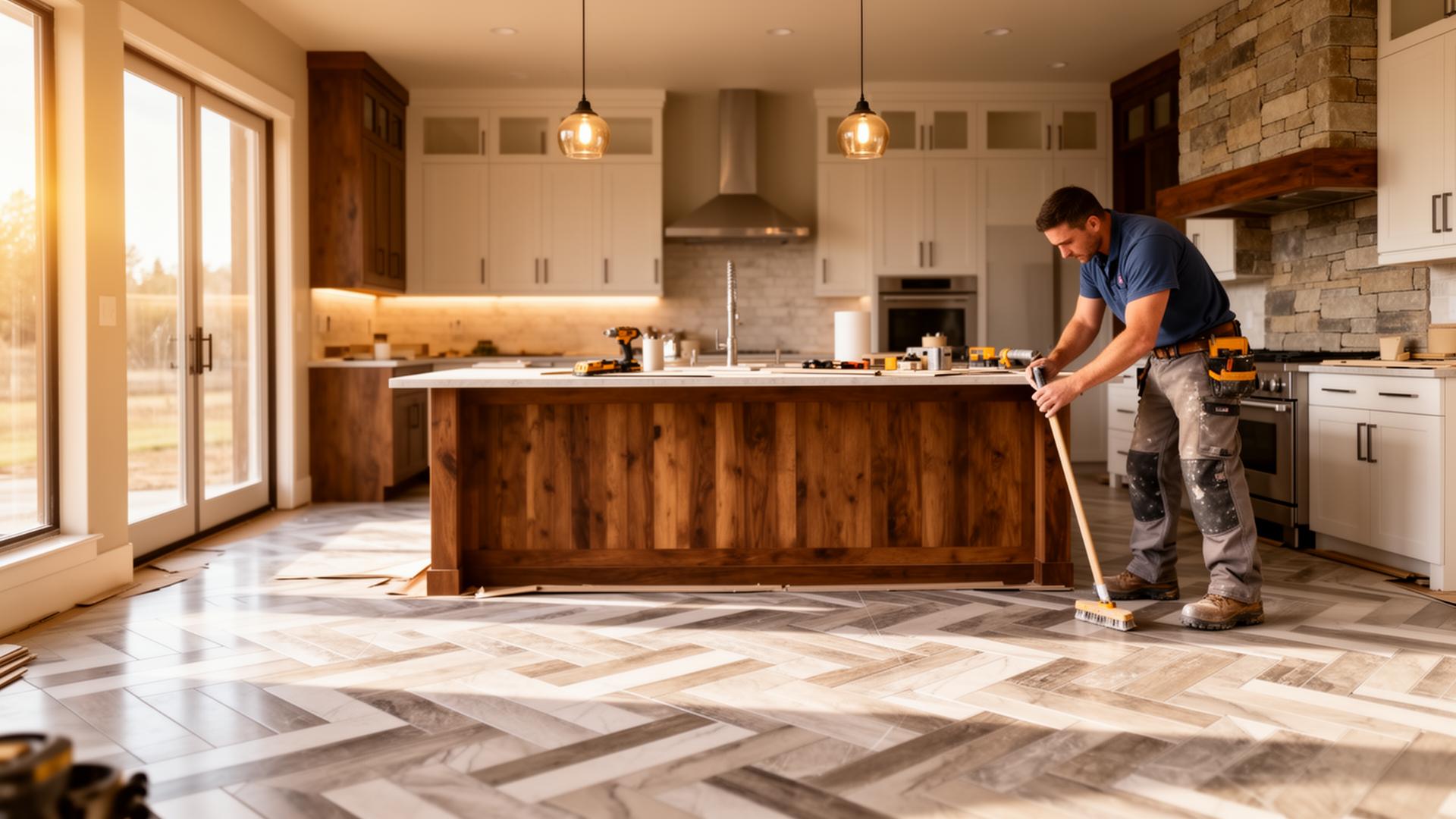
Anything with an edge longer than 15 inches is large-format by industry definition, which covers most of what people buy now: 12x24 floors, 24x48 walls, and gauged porcelain panels running several feet in each direction.
Large tile is less forgiving than small tile in every direction. It cannot bend to follow a wavy floor, it shows lippage at every joint, and it needs mortar coverage that a standard notch trowel and a quick set will not deliver.
Flatness is the whole job
A large tile spans imperfections instead of following them, so every dip in the floor becomes a rocking tile and every hump becomes a raised edge you catch with your foot. The standard for tile over 15 inches is 1/8 inch in 10 feet. Very few existing floors meet it, so self-leveling underlayment or wall skim coat is a normal, expected line item on a large-format estimate — not an upsell.
Offset limits are real
Most large-format tile has a slight crown along its length. Run it in a traditional 50 percent brick offset and the high center of one tile meets the low end of the next, producing lippage you cannot trowel out. Manufacturers cap the offset at roughly one third for this reason. If you want a 50 percent look, we talk about it before ordering, not after the first row.
Coverage, not adhesive strength
Large tile requires close to full mortar contact — the standard calls for 80 percent in dry areas and 95 percent in wet areas with no voids at corners. We use LHT mortar, comb in one direction, back-butter the tile, and periodically pull a set tile to look at the back. Unsupported corners are how large tile chips under a dropped pan.
Handling and cutting panels
Gauged panels need suction frames, two or three people, and wet cutting on a rail. Cutouts for outlets and fixtures get drilled at the corners so a square inside corner does not become a crack propagating across a four-foot panel. This is slower work and we schedule it that way.
How the work runs
Survey
Straightedge the floor or wall and record where it is out of tolerance.
Flatten
Self-leveling underlayment, patch or skim coat to bring the plane into spec.
Dry layout
Confirm offset, direction and where cuts land against sightlines.
Set
LHT mortar, back-buttering, directional troweling and leveling clips.
Finish
Remove clips, grout with the right joint width, and detail movement joints.
Questions about large-format tile
- Can large-format tile have thin grout lines?
- Rectified tile can go down to about 1/16 to 1/8 inch. Non-rectified tile needs a wider joint to absorb its size variation. Tighter joints also leave less room to absorb lippage, so the tighter you go, the flatter the substrate has to be.
- Why does my quote include self-leveling underlayment?
- Because the floor was measured and it did not meet the flatness the tile requires. Setting large tile on an out-of-tolerance floor produces lippage and hollow spots no amount of skill fixes afterward.
- Is large-format tile good for small bathrooms?
- It often is. Fewer grout lines make a small room read larger and reduce the grout you have to clean. The constraint is cuts — a small room may leave you with narrow slivers, which we plan around in the layout.
- Can you install porcelain panels on my fireplace or shower walls?
- Yes. Panels need a flat, plumb, properly prepared wall and, in a shower, a waterproofing system compatible with the panel adhesive. We assess the wall first because a panel will telegraph anything behind it.
Large-Format Tile across the Treasure Valley
Looking for something else? See all 8 tile services.